


How to Use Drama Games to Help Kids Navigate Social Circles - Social Skills Activities for Kids

As a new school year kicks off, parents naturally focus on back-to-school prep: backpack runs, new school supplies, and adjusting sleep schedules. But underneath the excitement of new clothes and colorful notebooks, many children are carrying a quiet weight: back-to-school social anxiety.
When we talk about performance and theater, we often focus on broad benefits like "building confidence,” but making friends isn't just a feeling; it’s a specific set of physical and interpersonal skills. Knowing how to step into a new circle at recess or sit next to someone new at lunch requires real-world mechanics: making eye contact, reading body language, interpreting vocal tone, and managing the timing of a conversation.
That is where theater steps in—not just as an art form, but as a safe, low-stakes social laboratory.
Through playful character interactions and group exercises, theater gives kids a space to test-drive these micro-skills before applying them on the playground. Here is how drama games break down the mechanics of connection and give kids concrete tools to build lasting friendships.
1. The "Statue & Mirror Game Helps Kids Learn How to Decode Body Language
So much of human communication happens without saying a word. On the playground, knowing whether a group is open to joining or closed off comes down to reading subtle physical cues.
In theater, body language is our primary storytelling tool. Games like Mirroring (where two actors face each other and copy movements in real-time) or Freeze Statues (where kids freeze into emotional poses) force children to slow down and observe non-verbal signals.
The Skill Learned: Kids learn to look beyond words. They practice identifying welcoming postures, like open shoulders and relaxed facial expressions, versus closed-off cues.
The Playground Application: Instead of feeling overwhelmed by a crowded playground, your child learns to scan the room visually, spot welcoming body language, and approach groups with much more ease.
2. Drama Exercises Help with Eye Contact and Non-Verbal Cues
For shy or anxious kids, walking up to a new peer and starting a conversation can feel terrifying. Drama games break down this initial barrier by isolating eye contact and turn-taking in fun, playful ways.
Exercises like Zip Zap Zop or Passing the Energy require players to make direct, intentional eye contact with a teammate before sending a physical gesture or word across the circle.
The Skill Learned: Practicing eye contact in a game context removes the social pressure. Kids experience firsthand how eye contact creates focus, connection, and mutual agreement.
The Playground Application: When looking for how to help your child make friends, starting with low-pressure eye contact is key. Drama games make eye contact feel like a fun game of catch rather than a nerve-wracking test, making that initial "Hi, can I play?" feel far more natural.
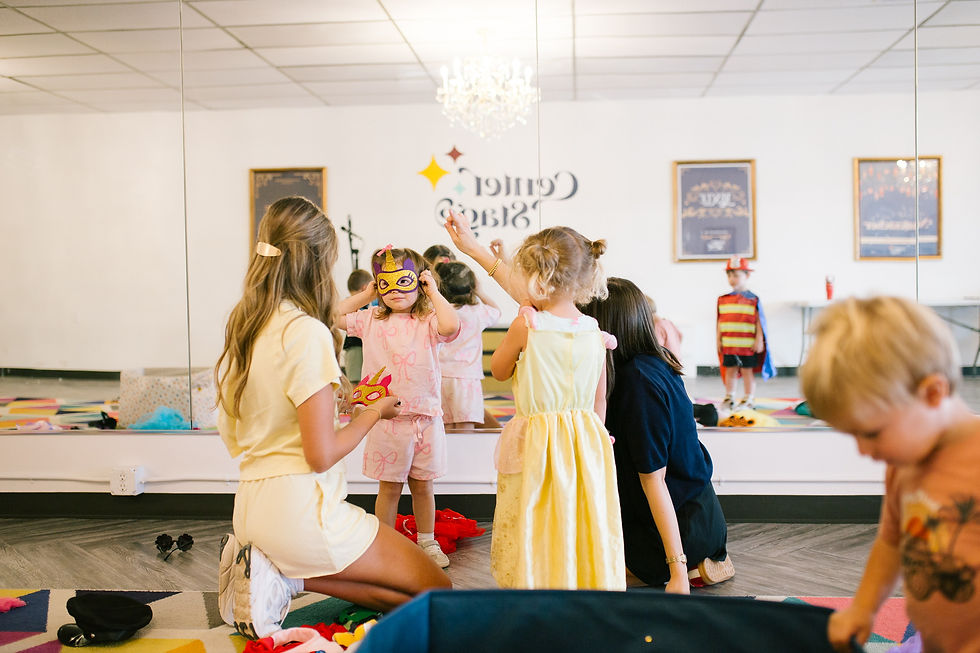
3. Tuning Into Vocal Tones Help Kids Learn to Listen Beyond the Words
It’s not just what we say; it’s how we say it. Understanding sarcasm, enthusiasm, or hesitation requires kids to tune into vocal inflections and volume.
Through vocal warm-ups and line-interpretation games—where kids say the exact same phrase (like "It's time to go") using five completely different emotions—young actors learn how much meaning is packed into the vocal tone.
The Skill Learned: Auditory decoding and active listening. Children begin to recognize emotional nuance in voice pitches and speeds.
The Playground Application: Interpreting vocal cues helps kids navigate delicate lunchroom dynamics, knowing when a peer is truly joking, when someone needs space, or when an invitation is genuine.
4. Improv Helps Kids Embrace Everyday Flexibility
Social interactions rarely follow a script. Recess games change rules mid-play, lunch seats shift, and conversations take unexpected turns. For children who thrive on predictability, unscripted social settings can provoke anxiety.
Improv exercises are built on one foundational rule: "Yes, and..." This rule teaches kids to accept whatever scenario a partner offers ("Yes") and build upon it with their own idea ("And...").
The Skill Learned: Conversational reciprocity and cognitive flexibility.
The Playground Application: If a peer changes the game rules at recess, an improv-trained child doesn't panic or shut down. They’re equipped to say "Yes, and…," adapting to the flow of play while still contributing their own voice.

Theatre as a Launchpad for Everyday Social Confidence
When utilizing social emotional learning activities for kids, like drama and theater, kids don’t just learn how to act on a stage; they are actively rehearsing for life.
By taking the mystery out of social mechanics—breaking eye contact, body language, and vocal tone into bite-sized, practice-able steps—theater transforms potential social anxiety into playful exploration.
If you're looking for impactful social activities for kids or effective social skills activities for kids this season, consider stepping into the theater space. With a little practice in the studio, your young performer will step onto the schoolyard equipped with the tools, self-assurance, and empathy needed to make new friends with ease.


Comments